November 20, 2026 · Dr. Frederik G. Pferdt What could you put down before the year ends? |
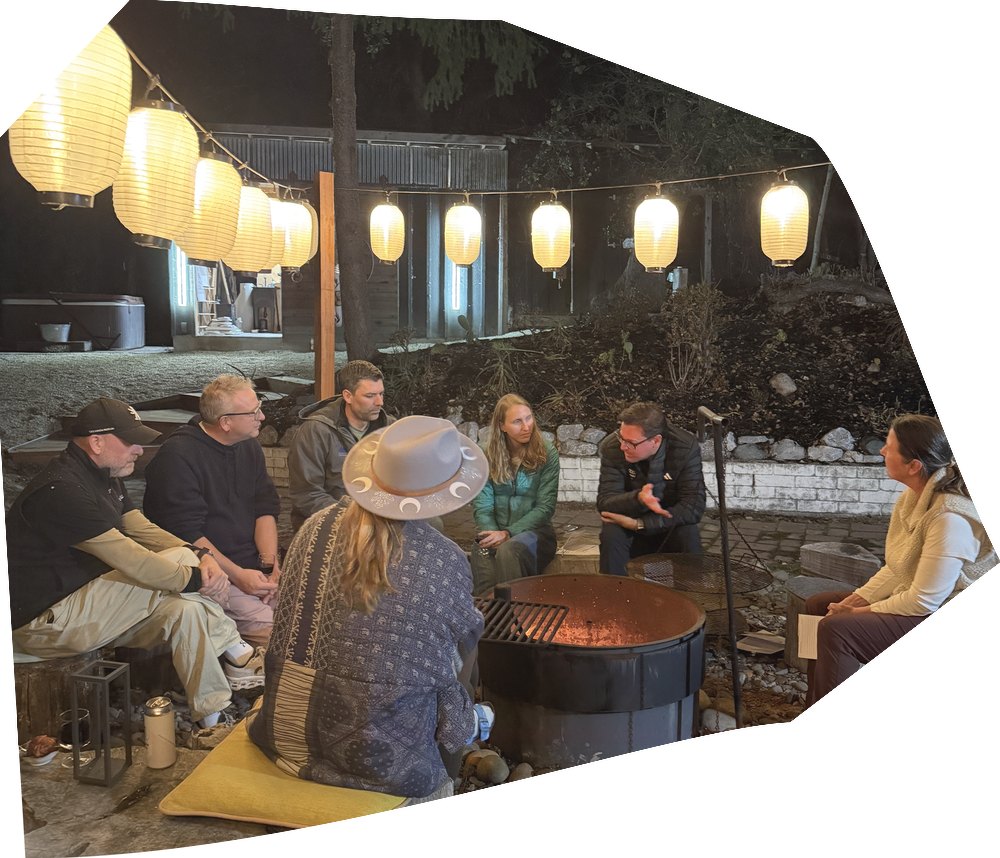
Dear friend, Two weeks ago, 8 people sat around a fire at our home in the Santa Cruz Mountains. One had flown in from Berlin, one from Zurich, one lives just down the road, others run a farm and some came from Silicon Valley. It was the first evening of our first Metreat. We had made pizza together, the sky had turned dark, and before anyone spoke about what's next, Angela and I asked a simpler question. |
| What are you ready to let go of? |
|
One by one, we answered. Some let go of a story they had been telling about themselves. One let go of a past that weighed heavily. One let go of the perfect picture of a life we are supposed to pursue. I let go of my titles, and of what they mean to me and to others. We call this ritual Let Go to Grow. Sitting there, I noticed how rare a moment like this is. We have many rituals for beginning things, and very few for ending them. That is especially true right now. The last weeks of the year are when most of us add: plans, goals, gifts, lists for January. So this NEXTletter asks the opposite question. |
◆ One question What could you put down
before the year ends? |
|
It could be an object. It could be a project that is finished in your heart but still on your list. It could be an expectation, a grudge, or a story about yourself that is a few years old. |
01 · Perspective one We are built to add |
When we want something to get better, we reach for more. Researchers showed how deep this goes. They asked 91 people to make a pattern of colored squares symmetrical, either by adding squares or by taking some away. Only 18 of them took something away. In another task, people had to stabilize a small Lego roof. Adding a brick cost ten cents. Removing one was free and solved the problem. Still, only 41 percent removed it. When people were reminded that taking away was an option, nearly two thirds did. The researchers' explanation is simple. Adding comes to mind first. Taking away is just as available to us, but we have to go looking for it. The end of the year is one long season of adding. So if nobody reminds us, we will plan the next year on top of everything we already carry. Consider this your reminder. |
02 · Perspective two Letting go is how you make room |
At Google X, the moonshot factory, my colleagues created a ritual for the projects that did not work out. On the Day of the Dead, people were invited to bring forward what they were ready to let go of and lay it into a coffin: a prototype, a business plan, a few sticky notes with sketches of an idea. X has been open about this. Astro Teller, who leads it, once described ending a project in automated vertical farming even though the team was already growing lettuce. What I learned there: a project you keep half alive occupies the exact place where your next one would begin. Ending it well gave people their energy back. That day carries an old wisdom. On November 1 and 2, families in Mexico celebrate Día de Muertos. They build an ofrenda, an altar with photographs, candles, marigolds and favorite foods, to welcome back the people they have lost. It taught me that letting go and forgetting are two different things. You can honor what was and still open your hands. Buddhist teaching has said something close to this for 2,500 years. Suffering begins with clinging: to things, to outcomes, to who we think we are. What frees us is an open hand. You can care deeply about something and still hold it lightly. |
| Science is catching up with the fire, too. |
|
Rituals work, even for skeptics. In one experiment, people lost a 200 dollar lottery. Some of them then drew how they felt, sprinkled salt on the drawing and tore it up. They felt the loss less than those who only drew, and it helped whether or not they believed in rituals. Reading about a ritual did nothing. Doing one did. Forgiveness may be the heaviest thing to put down, and the lightest feeling after. Research links forgiving with less anxiety and less depression, mostly because it ends a stress we keep feeding. Forgiving does not require reconciliation. As one of the researchers puts it, forgiveness "happens inside my skin". It is something you do for your own future. Every gardener knows this. A bed is cleared before it is planted. What's next needs a place to land, and you are the one who makes that place. |
◆ One experiment Your small fire Ten minutes, today. All you need is a piece of paper and a pen. Step 1 · Name it. Write down one thing you are ready to put down before December 31. A project, an expectation, a grudge, a habit, an object. Step 2 · Thank it. Underneath, write one sentence about what it gave you or taught you. Step 3 · Release it. Tear the paper into pieces, or burn it safely in a fireplace. Let your hands do what your mind has already decided. Step 4 · Name the space. Say one sentence out loud: "I am making room for ..." Step 5 · Share one word. Reply to this email with the one word that describes how you feel now. I read every reply. |
|
FFF: Frederik's Future Favorite Our Sake Club, Berlin |
|
In Kreuzberg, where a Späti used to be, there is now a room with almost nothing in it. One long table of ash wood. Two turntables. Sake from small breweries in Japan and a few simple things to nibble on. Techno pioneer Richie Hawtin opened it with friends, and it feels like his best sets: what is left out is part of the music. I went twice with a friend, which I almost never do with a restaurant or a hotel. Both times I sat at that table and noticed how little I missed. With so little in the room, what stayed got my full attention: the glass in my hand and the person across from me. If Berlin is far away, borrow the idea. Tonight, take three things off your table before you sit down. |
≈ The Future Is HOW On the podcast |
|
Some of what we carry sits in our calendar. In the latest episode of my podcast The Future Is HOW, I talk with Steven Rogelberg, who has studied meetings for decades. He offers one question that works like a small fire for your week: |
| Do you really need this meeting? |
|
On December 1, I open this year's December calendar: One less, more next. Every morning for 31 days, you receive a short voice message from me in our WhatsApp group, with one thing to release that day. Most calendars add something to your life. This one takes something away, one small thing each morning, so you step into the new year lighter and with room for what's next. |
From within.  | With care and love,
Frederik |
|
P.S. Curious to sit at that fire yourself? We will announce the next Metreat on the Metreat page. |
|